Italy Plans Burqa-Niqab Ban in Schools and Foreign Student Cap: What Meloni Announced
Rome/New Delhi | September 21, 2026
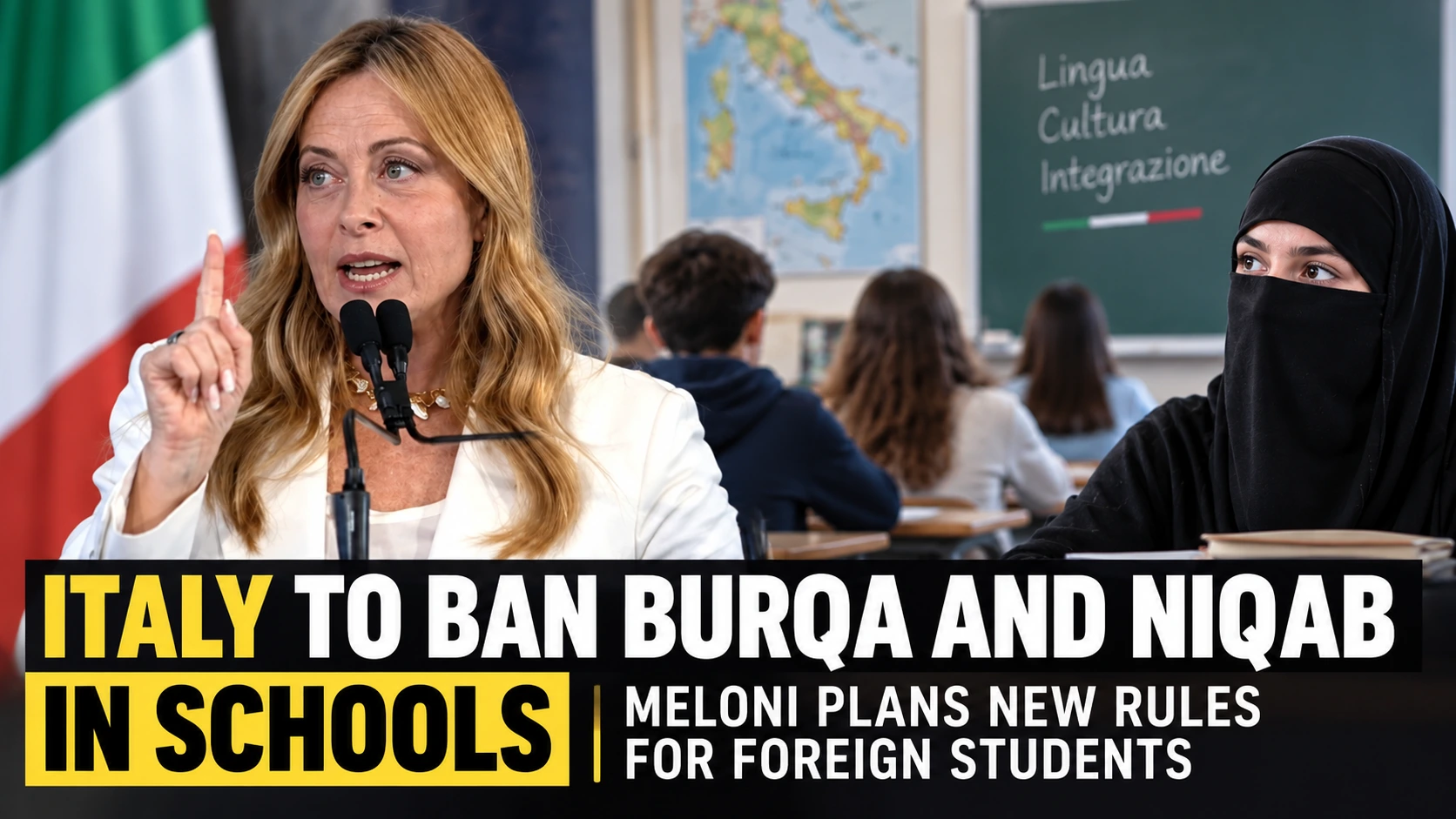
Italy burqa niqab ban in schools is among the measures proposed by Prime Minister Giorgia Meloni as part of a broader package on school integration, foreign students and the use of the Italian language.
Meloni announced the proposals during the Fenix festival in Rome, saying her government would introduce measures covering face coverings in schools, the number of foreign students allowed in individual classrooms and Italian-language learning for some parents of foreign pupils.
The proposals have not yet become law. The government must first approve the measure, after which the relevant legislation would have to pass through Parliament.
Italy Burqa Niqab Ban in Schools: What Meloni Announced
Meloni said the upcoming measure would introduce three major school-related provisions.
The government plans to:
- establish a legal maximum for the number of foreign students in each classroom;
- require parents of foreign students experiencing serious difficulties integrating into the Italian school system to learn Italian; and
- prohibit face-covering garments including the burqa and niqab in schools, according to international reports.
The announcement was presented by Meloni as part of a broader approach to integration, language education and the role of Italian schools.
She argued that integration becomes more difficult when a large proportion of pupils in a classroom cannot communicate effectively in Italian.
Meloni also said that students coming to Italy should learn the Italian language, understand the country’s culture and follow its rules.
Why Is Italy Planning a Burqa Niqab Ban in Schools?
The proposed classroom limit is linked to a long-running debate in Italy over the integration of pupils who do not hold Italian citizenship.
According to figures cited in recent reporting, students without Italian citizenship account for around 11.6% of pupils in Italian schools, although their distribution varies considerably between regions and individual schools. Reuters reported the same national share in its coverage of Meloni’s announcement.
The issue is particularly significant in areas where migrant-origin students are concentrated in particular schools or neighbourhoods.
Meloni argued that when a large number of pupils in a classroom struggle with the language, the challenge is different from having a small number of students who need additional language support.
Her position is that schools should promote integration rather than allow linguistic separation to become entrenched.
Italy’s Foreign Student Classroom Limit
The announcement is notable because Italy already has a policy concerning the concentration of students without Italian citizenship.
A 2010 education ministry circular introduced a general 30% guideline for pupils without Italian citizenship in a class. The measure was intended to prevent excessive concentration of students with foreign backgrounds in particular classrooms and schools.
However, the existing framework is not the same as the new law proposed by Meloni.
The government has not yet explained whether the planned legislation would simply give statutory force to the existing guideline, modify the percentage or establish a different system based partly on students’ Italian-language abilities.
That distinction will be important when the government publishes the actual text of the measure.
What the Italy Burqa Niqab Ban Would Actually Cover
The national figure does not tell the whole story.
Foreign pupils are not distributed evenly throughout the Italian education system. Some northern regions have significantly higher concentrations than the national average.
Lombardy, for example, has one of the country’s largest populations of pupils without Italian citizenship. Other regions with substantial numbers include Emilia-Romagna, Veneto, Lazio and Piedmont.
Another important factor is that foreign citizenship does not necessarily mean that a student recently arrived in Italy.
A significant proportion of pupils without Italian citizenship were born in Italy. This has become an important part of the debate over how the term “foreign student” should be understood in education policy.
The distinction matters because a child born and raised in Italy may have a very different level of Italian-language proficiency from a student who has recently arrived from another country.
What does the proposed face-covering ban mean?
Meloni also announced restrictions on face coverings in schools.
International reports from Reuters and AP describe the proposal as a ban on burqas and niqabs in Italian schools.
A burqa is a garment that covers the body and face, while a niqab covers the face while generally leaving the eyes visible.
Italian news agency ANSA’s initial report quoted Meloni as referring to a ban involving the burqa and hijab, creating some variation in early reporting about the exact terminology used in her speech.
For that reason, the final scope of the rule will become clearer only when the government’s formal legal text is published.
Meloni framed the issue around the principle that students should attend school with their faces visible and connected the proposal to equality between men and women.
She argued that cultural or traditional practices should not be used to justify requiring young women to cover their faces in school.
Importantly, the announcement should not currently be described as a nationwide ban on the hijab in all public places. The government proposal concerns schools, and the precise wording of the legislation remains pending.
Is burqa or niqab already banned across Italy?
No nationwide law currently bans the burqa or niqab across all public spaces in Italy.
Italy has previously debated restrictions on face-covering garments, and the issue has periodically returned to the country’s political agenda.
Meloni’s latest announcement focuses specifically on schools.
The proposal would therefore represent a new education-related restriction rather than an immediate nationwide prohibition covering every public space.
Why are parents being asked to learn Italian?
Another element of the proposed package concerns parents.
Meloni said parents of foreign students who experience serious difficulties integrating into the Italian school system could be required to learn Italian.
The government’s argument is that integration cannot depend only on children.
Language can affect communication between schools and families, participation in education and a student’s ability to navigate the school system.
The details remain unclear, however. The government has not yet publicly established how the requirement would be enforced, which parents would be covered or what consequences would follow if a parent failed to comply.
Those details will likely become clearer when the measure is formally presented.
A separate change for technical and vocational schools
Meloni also announced another education-related change at the Fenix event.
She said technical and vocational institutes would be able to use the designation “liceo”, a term traditionally associated with Italy’s academic secondary-school pathways.
The stated objective is to give technical and vocational education a status comparable to more academically oriented schools.
Meloni presented the change as part of an effort to make clear that students following vocational and technical routes should not be regarded as receiving an inferior form of education.
Why the announcement matters politically
The proposals come as immigration and integration remain major political issues in Italy.
Meloni’s Brothers of Italy government has made migration, national identity and integration central parts of its political agenda.
The timing is also significant because Italy is expected to hold its next general election in 2027.
The government is simultaneously facing pressure from political forces further to the right, including the movement associated with former general Roberto Vannacci.
Against that background, Meloni’s Fenix speech placed education, migration, language and cultural integration together in a single policy message.
However, the political implications should be separated from the legal status of the announcement: the measures are proposals at this stage and have not yet entered into force.
What happens next?
The next major step will be the government’s consideration of the proposed measure by the Council of Ministers.
If the government approves legislation, it would then move into the parliamentary process.
Until the final text is published, several important questions remain unanswered:
- What percentage or number of foreign students will be permitted in each class?
- Will the existing 30% guideline be retained or changed?
- Will the rule apply according to citizenship, language proficiency or another criterion?
- Exactly which face coverings will be prohibited?
- Will the restriction apply to students, staff or both?
- Which parents would be required to learn Italian?
- How would the language requirement be enforced?
These details will determine how the proposal works in practice.
The bigger debate over integration in Italian schools
Meloni’s proposal has reopened a broader question facing many European education systems: how should schools balance integration, language support, cultural diversity and equal access to education?
Supporters of stricter limits argue that schools need a common language and that excessive concentration of newly arrived or non-Italian-speaking pupils can make integration more difficult.
Critics, meanwhile, question whether citizenship is an appropriate measure for determining classroom composition, particularly because many pupils without Italian citizenship were born or raised in Italy.
The debate is therefore not simply about the number of foreign students.
It also concerns how Italy defines integration, how schools support pupils who are learning Italian and how the education system should respond to increasingly diverse classrooms.
For now, Meloni has announced the direction of the government’s proposed policy. The precise rules will depend on the legislation that eventually reaches Parliament.
The key point: Italy has announced a proposed school policy — it has not yet enacted a nationwide law banning burqas or niqabs in schools or establishing a new foreign-student classroom quota.
