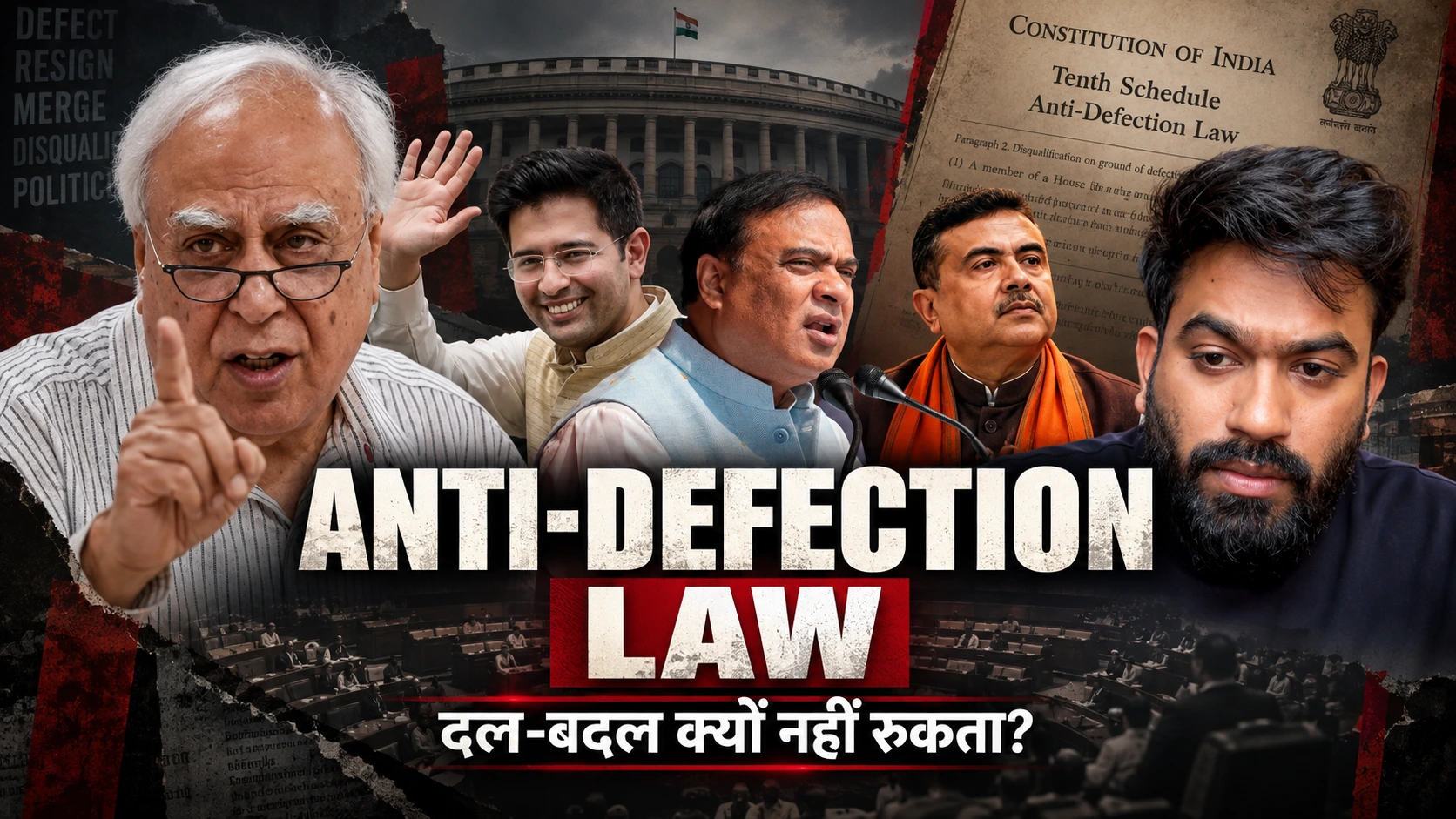
Anti-Defection Law in India: Tenth Schedule, Political Defections and the Big Loophole
What happens when voters elect a candidate on the symbol and manifesto of one political party, but that elected representative later switches to another party?
Is it simply an individual’s political decision or does it alter the mandate that voters gave at the election?
That question has once again come to the centre of India’s political debate.
The Anti-Defection Law in India, introduced through the 52nd Constitutional Amendment in 1985, was designed to discourage elected representatives from switching political parties for political advantage. The law was inserted into the Constitution through the Tenth Schedule.
But decades later, political defections remain a recurring feature of Indian politics.
The latest controversy has brought renewed attention to the two-thirds merger provision under the Tenth Schedule, the role of Speakers in deciding disqualification petitions, and a proposal by senior advocate and Rajya Sabha MP Kapil Sibal for a much stricter approach to party switching.
So, what exactly does India’s Anti-Defection Law say? Why can large groups of legislators sometimes switch parties without losing their seats? And could the law itself be changed?
Let’s break it down.
What Is the Anti-Defection Law in India?
India’s Anti-Defection Law was introduced through the 52nd Constitutional Amendment Act, 1985, which added the Tenth Schedule to the Constitution.
The basic objective was to address the problem of elected representatives changing political allegiance after elections.
The concern was straightforward.
If a candidate wins an election on the ticket of Party A and subsequently joins Party B, that move can potentially alter the political balance created by the election.
The law therefore created circumstances in which an MP or MLA can face disqualification for defection.
However, the law does not prohibit every form of political movement. It contains specific provisions dealing with defection, resignation, voting against party directions and mergers.
And that is where the controversy becomes complicated.
Why Does Political Defection Matter?
Consider a simple example.
Suppose Party A wins an election and forms a government.
A voter chooses a candidate because that candidate is contesting on Party A’s symbol and representing Party A’s political programme.
After the election, however, that legislator joins Party B.
The political representative has changed sides, but the voters who elected that representative did not get another opportunity to approve or reject the change.
This is why political defections are often discussed in the context of the electoral mandate.
At the same time, there is another side to the issue.
Elected representatives may argue that political parties themselves change positions, alliances and policies, and that legislators should retain some degree of political freedom.
The Anti-Defection Law therefore attempts to balance individual legislative freedom with party-based electoral mandates.
The Tenth Schedule: Where the Anti-Defection Rules Come From
The Tenth Schedule is the constitutional foundation of India’s Anti-Defection Law.
Among other things, it provides grounds on which members of Parliament and state legislatures can become subject to disqualification.
But the Tenth Schedule also contains an important exception relating to mergers.
This provision has become one of the central issues in the current debate.
The Two-Thirds Merger Rule Explained
Under Paragraph 4 of the Tenth Schedule, disqualification on the ground of defection does not apply in circumstances where a merger takes place and not less than two-thirds of the members of the legislature party have agreed to the merger.
In simple terms, if at least two-thirds of the relevant legislators move together under a merger arrangement, they can avoid disqualification under the merger exception.
This provision was intended to distinguish a genuine political merger from individual defections.
But critics argue that the provision can also create a route for mass defections to be structured as a merger.
That is the legal and political question now attracting renewed attention.
Why the Two-Thirds Rule Has Become Controversial
Imagine that a political party has 30 legislators.
If at least 20 of them – the required two-thirds move under a merger arrangement, the move can potentially fall within the protection of Paragraph 4.
That is fundamentally different from one or two legislators independently leaving their party.
The controversy is therefore not simply about whether legislators can change parties.
It is about whether a sufficiently large group can collectively change political allegiance without facing the disqualification that would apply to individual defectors.
The issue has become particularly visible following several large-scale political realignments.
The AAP Rajya Sabha Merger: A Recent Example
In April 2026, seven Aam Aadmi Party Rajya Sabha MPs joined the BJP, leaving AAP with three members in the Upper House.
The seven MPs were Raghav Chadha, Sandeep Pathak, Ashok Mittal, Harbhajan Singh, Rajinder Gupta, Swati Maliwal and Vikramjit Sahney. The seven-member group represented more than two-thirds of AAP’s Rajya Sabha strength at the time.
The Rajya Sabha Chairman subsequently accepted the merger, and the BJP’s strength in the Upper House increased to 113 while AAP’s strength fell to three.
This episode provides a useful real-world example of why the two-thirds merger provision matters.
The issue was not treated simply as seven individual MPs switching parties. The move was presented and accepted as a merger involving the requisite proportion of AAP’s Rajya Sabha members.
That distinction is at the heart of the present debate over the Tenth Schedule.
The Bigger Question: Who Owns the Mandate?
This leads to a broader constitutional and democratic question.
When voters elect a representative on a party symbol, what exactly are they choosing?
Are they choosing only the individual candidate?
Or are they also choosing the political party, its manifesto and its stated programme?
India’s parliamentary system combines both individual representatives and political parties. In many constituencies, voters make their choice based not only on the candidate but also on the party’s national or state-level leadership, manifesto and policies.
Therefore, when an elected representative changes political affiliation midway through a term, supporters and critics can interpret the consequences differently.
Supporters may call it political freedom.
Critics may call it a departure from the electoral mandate.
The Anti-Defection Law exists largely because this tension can affect the stability of elected governments and the functioning of legislatures.
The Indian Express Investigation and the Question of Political Defections
The debate becomes even more complicated when political defections intersect with corruption investigations.
An April 2024 investigation by The Indian Express examined 25 prominent opposition politicians who had faced corruption-related action by central agencies and subsequently crossed over to the BJP since 2014.
According to the investigation, 23 of the 25 cases showed what the newspaper described as a reprieve after the political switch: three cases were closed while 20 were stalled or showed little subsequent action.
These findings generated political controversy, with opposition parties alleging that investigative agencies had been used selectively.
However, this should not be presented as proof that joining another political party automatically causes an investigation to be dropped.
The Indian Express itself reported responses from government officials. The Enforcement Directorate said its actions were driven by legal mandates and evidence, while a CBI official said investigations remain open where evidence warrants further action.
Therefore, the evidence establishes a documented pattern identified by the newspaper, while the explanation for that pattern remains politically contested.
That distinction matters.
Kapil Sibal’s Proposal to Change the Anti-Defection Law
The latest debate has also brought senior advocate and Rajya Sabha MP Kapil Sibal into the spotlight.
On July 20, 2026, Sibal filed a petition in the Supreme Court seeking an authoritative interpretation of Paragraph 4 of the Tenth Schedule.
According to the Supreme Court Observer’s summary, the petition argues that a narrow interpretation of the merger provision can facilitate mass defections and horse-trading. On July 27, a Supreme Court bench comprising Justices P.S. Narasimha and Alok Aradhe issued notice in the matter.
This is important because the Supreme Court has not yet finally decided the petition.
The matter concerns how the constitutional merger provision should be interpreted and whether the existing framework adequately addresses large-scale defections.
Sibal’s 10-Year Proposal
The debate moved beyond the courtroom in September 2026.
Speaking at an event organised by the All India Lawyers Union in Kochi, Sibal argued that the Tenth Schedule needs a fundamental overhaul.
He proposed a simple constitutional rule under which a legislator who changes political parties during an ongoing term would be barred from holding public office or constitutional authority for 10 years.
He also argued that the concept of a merger should refer to an actual merger of political parties rather than simply a collective movement of legislators.
This is different from the 20-year penalty demanded by the Cockroach Janta Party (CJP).
CJP has backed Sibal’s proposal but has separately called for a 20-year bar on legislators who switch parties after being elected on another party’s symbol.
The distinction is important: 10 years is Sibal’s proposal; 20 years is CJP’s separate demand.
Why the CJP Has Entered the Debate
The Cockroach Janta Party has also made anti-defection reform one of its political demands.
Its demand charter calls for elected representatives who switch parties after winning an election to face a much longer restriction on contesting elections or holding public office.
The organisation has argued that party switching after an election can undermine the electoral mandate.
This puts the CJP demand alongside, but not identical to, Sibal’s proposal.
Both proposals focus on creating stronger consequences for mid-term defections, but they differ in the duration and structure of the proposed restriction.
The Role of the Speaker Is Another Major Issue
The Anti-Defection Law also raises questions about who decides whether a legislator should be disqualified.
Under the existing framework, the Speaker or Chairman of the relevant House plays a central role in deciding disqualification petitions.
This creates a structural debate.
The Speaker is a constitutional authority, but the Speaker also emerges from the political system and is generally associated with the majority party or coalition.
Critics therefore argue that politically sensitive defection cases should not remain vulnerable to prolonged procedural delays.
Supporters of the existing arrangement, however, can point to the constitutional role of the Speaker and the need to preserve the legislature’s internal authority.
The question is therefore not merely whether the Anti-Defection Law should be stricter.
It is also about who should interpret and enforce it, and how quickly those decisions should be made.
What Happens in Other Democracies?
India is not the only democracy dealing with party switching.
But different parliamentary systems have adopted very different approaches.
United States: No Indian-Style Anti-Defection Law
The United States does not have an anti-defection framework equivalent to India’s Tenth Schedule.
Members of Congress can change party affiliation without automatically losing their elected seat simply because they switch parties.
The American political system therefore relies much more heavily on political accountability, party structures and elections rather than an Indian-style constitutional disqualification mechanism.
Canada: MPs Can Cross the Floor
Canada provides another interesting comparison.
In 2026, five MPs crossed the floor to join the Liberal caucus, including four Conservatives and one New Democrat. The defections helped the Liberals move toward a majority government.
Under Canada’s existing system, MPs can change party affiliation without automatically losing their parliamentary seats or triggering a by-election.
The issue nevertheless generated political controversy.
The NDP subsequently introduced legislation seeking to restrict floor-crossing and require approval from constituents before an MP could switch parties.
This illustrates an important difference between political systems.
A country does not necessarily need to impose automatic disqualification to create political consequences for floor-crossing.
Political parties, voters and Parliament can also become mechanisms of accountability.
Maldives: A Different Approach
The Maldives has moved in the opposite direction.
A constitutional amendment introduced in November 2024 created anti-defection provisions under which parliamentarians can lose their seats in circumstances including switching parties or being expelled from their party, as well as certain other forms of party affiliation change.
The amendment was challenged before the Maldivian Supreme Court.
In April 2026, the Supreme Court rejected the challenge and upheld the anti-defection provisions.
The Maldives example demonstrates that democracies can choose very different constitutional approaches to the same problem.
Some systems prioritise the individual legislator’s freedom to change political affiliation.
Others place greater emphasis on preserving party-based electoral mandates and parliamentary stability.
So, Does India’s Anti-Defection Law Need to Change?
That question ultimately involves constitutional design rather than one political party or one individual politician.
There are competing considerations.
A stricter Anti-Defection Law could make it harder for elected representatives to change political allegiance during their terms and could potentially reduce the scope for governments to be destabilised through mass defections.
But an excessively rigid law could also raise questions about the independence of legislators, internal party democracy and the ability of elected representatives to respond to legitimate political disagreements.
The two-thirds merger provision represents one attempt to address this balance.
The controversy is whether that exception still serves its original purpose or whether it has become a mechanism through which large-scale defections can take place without the consequences associated with individual defection.
That is precisely why the interpretation of Paragraph 4 of the Tenth Schedule has become so important.
The Real Question Is About the Electoral Mandate
Political parties will continue to form alliances, break alliances and change political positions.
That is part of democratic politics.
But the difficult question arises when an elected representative changes party after an election and that change alters the political balance created by voters.
The debate over the Anti-Defection Law in India is therefore ultimately a debate about the relationship between three things:
The voter.
The elected representative.
The political party.
Who does the mandate belong to?
What happens when the representative changes political allegiance?
And how should the Constitution respond when individual defections become collective movements capable of changing governments?
There are no simple answers.
The Supreme Court’s consideration of the current petition, Parliament’s approach to any future constitutional amendment, and the political response to recent defections could all shape the next phase of India’s anti-defection framework.
For now, the central question remains:
When voters choose a representative on a party symbol, should that mandate be capable of being transferred to another party before the voters get another chance to decide?
That is the question at the heart of India’s continuing debate over political defections and the Anti-Defection Law.
Sources and Further Reading
- The Indian Express – Investigation into opposition politicians who crossed over to the BJP and subsequent status of corruption cases. Read the Indian Express investigation
- The Indian Express – AAP Rajya Sabha MPs and the merger/disqualification question. Read the AAP Rajya Sabha explainer
- Supreme Court Observer – Kapil Sibal’s petition concerning Paragraph 4 of the Tenth Schedule. Read the petition summary
- LiveLaw – Kapil Sibal’s September 2026 proposal to overhaul the Tenth Schedule. Read the report
- New Indian Express – CJP’s separate 20-year demand. Read the report
- Maldives Supreme Court coverage – 2026 anti-defection ruling. Read the Maldives report
